CHORDS
A chord generator for the M-VAVE FM-1. Pick a scale and a root; the white keys play the scale's chords, the black keys its notes. Hold a button with a chord for its 7th, 9th, 6th, sus or its borrowed twin, as on the Orchid, or ENV to strum it. Load chord sets by mood, sketch a progression in eight boxes and loop it with the arp, a melody that follows the harmony and a bass under it, or let it generate one, find a route to a new key, or detect the key you're playing in. 36 sounds: the web app's twelve and 24 Orchid-style reed pianos, analog pads and FM keys.
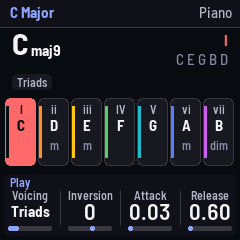
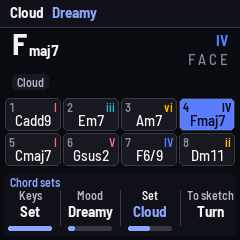
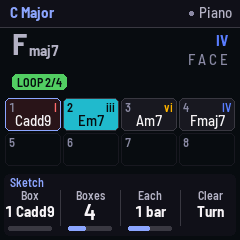
Playing
| White keys | The scale's chords, one per key: I, ii, iii... and on into the next octave. With Keys set to Set: a chord set on 1–8, the sketch on 9–16. |
| Black keys | The scale's notes, an octave above the chords. |
| Held with a chord | EDIT 7th · FX 9th · HOME 6th · SEL sus4 · SEQ sus2 · GLO major ↔ minor (the chord from the parallel key). They combine: EDIT + FX is a 9th chord. Tapped alone, the buttons open their pages. |
| ENV | Held with a chord: it strums, a note at a time (speed, direction and "always" on the Strum page). |
| LFO | Held: chords play single notes (their root). Press it twice quickly to lock single notes on; twice again for chords. |
| PLAY | HOLD: chords and notes keep sounding until the next one. Held, or pressed on a Sketch page: the sketch plays as a loop. |
| REC | Swaps the rows (notes on the white keys, chords on the black). On a Sketch page: the chords you play go into the boxes. |
| ARP | The arpeggiator on and off. Its Melody mode plays a generated phrase that follows the chords, taking a borrowed chord's own notes where the scale's would clash. |
| OCT− · OCT+ | The octave (2 to 5). |
| SELECT | Scale: Major, Minor, the modes, Harmonic and Melodic minor, the pentatonics, Blues, Whole tone, Locrian, Phrygian dominant, Lydian dominant, Hungarian minor, Double harmonic, Neapolitan minor, Hirajoshi, In-Sen. |
| ALGORITHM | Root. |
| PRESETS | Sound. Classic: Piano, E. Piano, Organ, Brass, Strings, Pad, Pluck, Bell, Saw, Square, Triangle, Sine. Reed piano: Suitcase, Tine Bell, Dyno Keys, Wurly, Wurly Trem, Lofi Keys. Analog: Warm Pad, Dream Pad, Silk Strings, Poly Strings, Synth Brass, Soft Lead, Square Lead, Analog Keys, Saw Stack, Velvet Pad. FM: DX Keys, Glass Pad, FM Bell, Celesta, Marimba, Crystal, Clav, FM Organ. The Orchid-style ones bring their own effects. |
| KNOB 1–4 | The four values on the screen. |
| SAVE | Saves. CHORDS also saves by itself a few seconds after a change, once it's quiet. |
The pages
Each page puts four values on KNOB 1–4. A page button opens its first page, and the next one when pressed again; EDIT steps through all eighteen.
- HOME: Play. Voicing (dyads to 11ths), Inversion (−3 to +3), Attack, Release.
- Play: strum. Strum (5–150 ms a string), Direction (Down, Up, Alternate), Strum when (ENV held, Always), Level.
- SEQ: Arp. Mode (up, down, up-down, random, melody), Rate (1/4 to 1/32, with triplets), Tempo (also the loop's), Gate.
- Melody: phrase. Form (Repeat, AABA, ABAB, ABAC, Call-answer, AAAB), Length (1 to 8 bars), Variation, Ends on.
- Melody: rhythm. Density, Syncopate, Swing, New (a new rhythm, the same notes).
- Melody: notes. Leaps, Contour, Passing notes, New (new notes, the same rhythm).
- Melody: ornaments. Grace notes, Octave jumps, Accents, Gate.
- Melody: voice. Volume, Octave, New all.
- FX: Effects, Filter, Drive. Reverb, Delay, Chorus, Tremolo; Low-pass, High-pass, Auto-filter, Vibrato; Overdrive, Bitcrush, Waveshape, Compressor.
- SEL: Chord sets. Keys (Scale or Set), Mood (Bright, Dreamy, Sad, Dark, Soul, Jazz, Gospel, Lo-fi, Trap, House, Cinematic, Pop), Set (36 sets of 8 chords), To sketch (turn: the set into the sketch).
- Sketch. Box (the cursor), Boxes (1–8), Each (half a bar, a bar, two bars), Clear.
- Generate. Style (Pop, Sad, Dreamy, Soul, Jazz, Gospel, Dark, Cinematic), Spice (borrowed chords, secondary dominants, tritone subs), Colour (7ths, 9ths, sus, add9), Generate (turn: a new progression into the sketch).
- Key change. To key, Scale, Route (pivot chord, ii–V, borrowed chord, Neo-Riemannian), Write (turn: the route into the sketch). The screen shows the route before you write it.
- Detect. Listen (MIDI in, the keys, both), Forget, Use key (turn: the key it heard), MIDI out. The screen names the chord held on MIDI in and shows the notes heard.
- GLO: Bass. Bass (off, one or two octaves under), Sound (Sine, Tri, Saw, Square and Bassline's 808, Finger, Pick, Slap, Muted, Fretless, Upright, Acid, Sub, Reese), Volume, Pattern (Hold, 8ths, Octaves, Root-5th, Offbeat, Walk, Tresillo).
- Setup. Level, Arp octaves, Tune, Lights.
MIDI
- In (USB and the TRS jack): notes on any channel play the current sound; Detect listens to them.
- Out (USB, on by default): chords and notes on channel 1, the bass on channel 2.
To go back to the official firmware, use the installer's "Back to the stock firmware", or M-VAVE's updater, M-UPGRADE, from m-vave.com/download. M-VAVE and FM-1 are trademarks of their owners. CHORDS is not affiliated with M-VAVE.